




Prisma Assessment For
Workplace Psychosocial Risk Management
A PRisMA assessment is a DOSH-endorsed process for managing workplace psychosocial hazards like workload and role clarity. It ensures Malaysian employers comply with Section 18B of OSHA 1994 (Amendment 2022) and the DOSH PRisMA 2024 Guidelines, while aligning with the ISO 45003:2021 international standard for psychological health and safety.
WHEN YOUR WORKPLACE NEEDS A PRISMA ASSESSMENT
A PRisMA assessment is required when responding to a DOSH directive after a reported case, during routine OSH audits, or when proactively fulfilling the employer’s duty of care under OSHA 1994 (Amendment 2022) to manage physical and mental health risks.
Common triggers include:
- A DOSH directive following an employee complaint or incident
- Rising absenteeism, turnover, or burnout reports
- Pre-audit preparation for ISO 45003:2021 alignment
- Internal HR / safety committee recommendation
LEO26 EMPLOYEE QUESTIONNAIRE
The LEO26 is a validated, DOSH-endorsed questionnaire that measures employee exposure to workplace psychosocial risks like work demand and job control. Crucially, responses are submitted directly to the PTP under strict confidentiality and are never visible to HR or management.
EPC23 EMPLOYER PRACTICE CHECKLIST
The EPC23 is the employer-facing companion tool used to document your current psychosocial risk management policies. Combined with the LEO26, it provides a balanced, two-sided view of employee experience versus employer practices, ensuring a defensible assessment.
PSYCHOSOCIAL RISK ANALYSIS AND FORMULATION
Our PTP analyzes the questionnaire data against DOSH benchmarks to pinpoint active hazards, exposed teams, and risk severity. This is a structured workplace risk evaluation—not a clinical diagnostic tool—that forms the foundation of your action plan.
RISK MANAGEMENT PLAN AND FINAL REPORT
Your concrete deliverable is a formal report detailing key findings and prioritized, risk-based interventions. This acts as both a practical roadmap for reducing psychosocial risk and your official compliance baseline for future DOSH audits.
THE ROLE OF THE PSYCHOSOCIAL TRAINED PERSON (PTP)
Under DOSH 2024 guidelines, only a registered PTP can deliver a formal PRisMA assessment. Biochem’s PTP operates within our ISO/IEC 17025 accredited environment, applying the same strict governance, confidentiality, and reporting standards we have maintained since 1977.
MENTAL HEALTH AWARENESS TRAINING
Turn assessment findings into proactive capability by pairing your PRisMA assessment with our HRD Corp claimable mental health awareness training. This helps you address the OSHA 2022 Amendment’s expanded definition of workplace health and prevents future risks from escalating.
WHY CHOOSE BIOCHEM
- Registered DOSH PTP Our certified Psychosocial Trained Person delivers PRisMA assessments fully compliant with the DOSH 2024 framework.
- ISO/IEC 17025 Accredited Laboratory Your PRisMA data is protected by the same strict governance and confidentiality standards used in our analytical testing.
- Since 1977 Backed by decades of experience supporting manufacturers across our Penang, Johor, and Selangor branches.
- One Vendor, Full OSH Stack Consolidate your CHRA, LEV, noise, indoor air quality, and PRisMA assessments under a single accredited provider.
Other Testing Services You Might Be Interested In
FAQ
What is a failure analysis service?
Failure analysis service is a laboratory investigation that identifies why a product, component, or material has failed. It combines visual examination, microscopy, chemical analysis, and material testing to determine the root cause and recommend corrective action.
What is the difference between failure analysis and quality testing?
Quality testing confirms whether a product meets specification before release. Failure analysis investigates a failure that has already occurred, identifying the cause so it can be prevented in future production.
What types of samples can Biochem analyze for materials failure analysis?
Biochem accepts metals, plastics, rubbers, electronic components, printed circuit boards, coatings, packaging materials, and finished products. For non-standard samples, contact our chemists for scoping before submission.
How long does a failure analysis investigation take?
Turnaround time depends on sample condition, analytical scope, and investigation complexity. Biochem also provides priority handling and express analysis options for urgent cases, subject to laboratory scheduling and additional express service charges.
Which techniques does Biochem use for failure analysis?
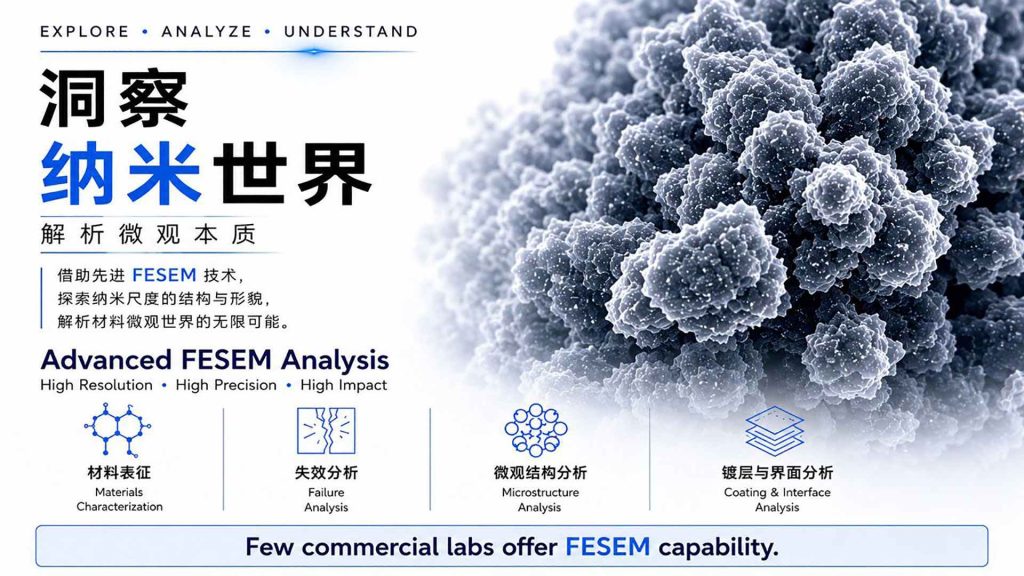
Depending on the investigation objective and sample condition, Biochem utilizes advanced analytical technologies including FESEM and FTIR to support detailed material characterisation and failure investigation.
Can Biochem provide cross-section analysis for failure investigation?
Yes. Biochem provides cross-section preparation and analytical evaluation to support detailed failure analysis and material characterisation investigations.
Cross-section analysis, also known as micro-sectioning, is a destructive analytical technique used to expose and examine the internal structure of a component beyond surface-level observation. Through precision cutting, mounting, grinding, and polishing processes, hidden defects and internal abnormalities can be evaluated in detail.
Does Biochem provide recommendations or just observations?
Both. Our reports include observed findings plus a root cause assessment and recommended corrective actions. A follow-up consultation with the lead chemist is included.
How do I request failure analysis service from Biochem?
Contact Biochem via the enquiry or quotation form, by email at info@biochem.com.my, or via WhatsApp at 012-425 9368. Kindly provide a brief description of the issue, sample type, and any relevant background information for preliminary technical evaluation. Our team will respond with the proposed analytical scope and indicative pricing.
Get In Touch
Looking to discuss your needs or get a quote from our electrical safety testing experts? Contact us today!